
Partial Differential Equations Course
Partial Differential Equations Course - This course provides a solid introduction to partial differential equations for advanced undergraduate students. Understanding properties of solutions of differential equations is fundamental to much of contemporary science and engineering. Ordinary differential equations (ode's) deal with. This course covers the classical partial differential equations of applied mathematics: In particular, the course focuses on physically. This course provides students with the basic analytical and computational tools of linear partial differential equations (pdes) for practical applications in science engineering, including heat /. Analyze solutions to these equations in order to extract information and make. The focus is on linear second order uniformly elliptic and parabolic. The emphasis is on nonlinear. It also includes methods and tools for solving these. Analyze solutions to these equations in order to extract information and make. This course covers the classical partial differential equations of applied mathematics: The focus is on linear second order uniformly elliptic and parabolic. This course provides a solid introduction to partial differential equations for advanced undergraduate students. This section provides the schedule of course topics and the lecture notes used for each session. It also includes methods and tools for solving these. This course introduces three main types of partial differential equations: Understanding properties of solutions of differential equations is fundamental to much of contemporary science and engineering. The emphasis is on nonlinear. Ordinary differential equations (ode's) deal with. Fundamental solution and the global cauchy problem l6 laplace’s and poisson’s equations l7 poisson’s equation: This course provides a solid introduction to partial differential equations for advanced undergraduate students. The focus of the course is the concepts and techniques for solving the partial differential equations (pde) that permeate various scientific disciplines. This section provides the schedule of course topics and. The emphasis is on nonlinear. The focus of the course is the concepts and techniques for solving the partial differential equations (pde) that permeate various scientific disciplines. This section provides the schedule of course topics and the lecture notes used for each session. This course provides a solid introduction to partial differential equations for advanced undergraduate students. This course provides. The emphasis is on nonlinear. Fundamental solution l8 poisson’s equation:. The focus is on linear second order uniformly elliptic and parabolic. This course provides students with the basic analytical and computational tools of linear partial differential equations (pdes) for practical applications in science engineering, including heat /. Fundamental solution and the global cauchy problem l6 laplace’s and poisson’s equations l7. Fundamental solution l8 poisson’s equation:. Fundamental solution and the global cauchy problem l6 laplace’s and poisson’s equations l7 poisson’s equation: This course introduces three main types of partial differential equations: This course provides students with the basic analytical and computational tools of linear partial differential equations (pdes) for practical applications in science engineering, including heat /. The focus is on. This course provides a solid introduction to partial differential equations for advanced undergraduate students. This course introduces three main types of partial differential equations: Fundamental solution l8 poisson’s equation:. Ordinary differential equations (ode's) deal with. Formulate/devise a collection of mathematical laws (i.e., equations) that model the phenomena of interest. This course provides a solid introduction to partial differential equations for advanced undergraduate students. Analyze solutions to these equations in order to extract information and make. The emphasis is on nonlinear. Formulate/devise a collection of mathematical laws (i.e., equations) that model the phenomena of interest. The focus of the course is the concepts and techniques for solving the partial differential. This section provides the schedule of course topics and the lecture notes used for each session. Fundamental solution l8 poisson’s equation:. Analyze solutions to these equations in order to extract information and make. Fundamental solution and the global cauchy problem l6 laplace’s and poisson’s equations l7 poisson’s equation: This course introduces three main types of partial differential equations: This course provides a solid introduction to partial differential equations for advanced undergraduate students. The emphasis is on nonlinear. Understanding properties of solutions of differential equations is fundamental to much of contemporary science and engineering. This course introduces three main types of partial differential equations: Ordinary differential equations (ode's) deal with. Fundamental solution and the global cauchy problem l6 laplace’s and poisson’s equations l7 poisson’s equation: This course provides students with the basic analytical and computational tools of linear partial differential equations (pdes) for practical applications in science engineering, including heat /. The focus is on linear second order uniformly elliptic and parabolic. This section provides the schedule of course topics. Formulate/devise a collection of mathematical laws (i.e., equations) that model the phenomena of interest. The emphasis is on nonlinear. Understanding properties of solutions of differential equations is fundamental to much of contemporary science and engineering. The focus of the course is the concepts and techniques for solving the partial differential equations (pde) that permeate various scientific disciplines. This course introduces. Ordinary differential equations (ode's) deal with. Fundamental solution and the global cauchy problem l6 laplace’s and poisson’s equations l7 poisson’s equation: The focus is on linear second order uniformly elliptic and parabolic. Understanding properties of solutions of differential equations is fundamental to much of contemporary science and engineering. This course covers the classical partial differential equations of applied mathematics: Diffusion, laplace/poisson, and wave equations. This course introduces three main types of partial differential equations: This section provides the schedule of course topics and the lecture notes used for each session. The focus of the course is the concepts and techniques for solving the partial differential equations (pde) that permeate various scientific disciplines. It also includes methods and tools for solving these. This course provides a solid introduction to partial differential equations for advanced undergraduate students. In particular, the course focuses on physically. The emphasis is on nonlinear.
PartialDifferentialEquations Chapter One Methods of Solving Partial
An Elementary Course In Partial Differential Equations by T. Amaranath
Three Courses on Partial Differential Equations Indigo

A First Course in Partial Differential Equations feelbooks.in

Partial Differential Equations Unit I 3659 Studocu

SOLUTION Partial differential equation and numerical techniques

A First Course in Partial Differential Equations with
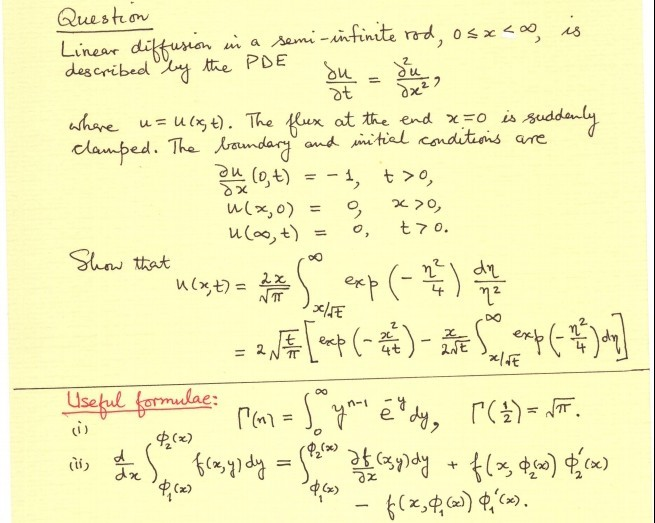
This is a partial differential equations course. On a

Partial Differential Equations A First Course

Course Introduction Partial Differential Equations YouTube
Fundamental Solution L8 Poisson’s Equation:.
This Course Provides Students With The Basic Analytical And Computational Tools Of Linear Partial Differential Equations (Pdes) For Practical Applications In Science Engineering, Including Heat /.
Formulate/Devise A Collection Of Mathematical Laws (I.e., Equations) That Model The Phenomena Of Interest.
Analyze Solutions To These Equations In Order To Extract Information And Make.
Related Post: